Inside AI Colosseum: How 16 AI Models Collaborate in One Unified Platform
👉 Try AI Colosseum for free — Access 16 AI models including ChatGPT, Claude, Gemini, and more from one unified platform. Start your free trial at aicolosseum.app.
The AI landscape in 2024 presents a paradox: we have more powerful AI models than ever, yet accessing them remains frustratingly fragmented. Users juggle multiple subscriptions, switch between different interfaces, and manually compare outputs. AI Colosseum solves this problem by bringing 16 leading AI models into a single, unified platform with groundbreaking multi-model collaboration features.
The Problem: AI Subscription Fatigue
Consider the typical AI power user in 2024:
• ChatGPT Plus subscription: $20/month
• Claude Pro: $20/month
• Gemini Advanced: $19.99/month
• Perplexity Pro: $20/month
That's $80/month minimum—and you still can't directly compare outputs or facilitate conversations between models. Each platform exists in isolation, forcing users to copy-paste between tabs, manually track context, and make subjective judgments about which model performs best for their specific use case.
Enter AI Colosseum: One Platform, 16 Models
AI Colosseum fundamentally reimagines how we interact with AI. Instead of treating each model as a separate silo, it creates an orchestration layer that enables seamless switching, side-by-side comparison, and—most innovatively—multi-AI collaboration.
The Model Roster
AI Colosseum integrates 16 leading AI models:
• OpenAI: GPT-4o, GPT-4o-mini, GPT-3.5 Turbo
• Anthropic: Claude 3.5 Sonnet, Claude 3 Opus, Claude 3 Sonnet, Claude 3 Haiku
• Google: Gemini 2.0 Flash, Gemini 1.5 Flash, Gemini 1.5 Pro
• Mistral AI: Mistral Large, Mistral Small
• xAI: Grok Beta
• DeepSeek: DeepSeek Chat
• Meta: Llama 3.1 (405B)
• Cohere: Command R+
This comprehensive roster ensures you always have access to the right model for the job—whether you need GPT-4o's reasoning capabilities, Claude's long-context understanding, Gemini's multimodal processing, or Perplexity's real-time web search integration.
Shared Conversation History: The Secret Sauce
Here's what makes AI Colosseum fundamentally different from using multiple AI tools separately: every AI model can see the entire conversation history from all other models. This isn't just a Round Table feature—it's how the entire platform works.
When you ask GPT-4o a question, then follow up with Claude, Claude sees your original question and GPT-4o's response. When you bring in Gemini, it sees everything that came before. This creates a continuous thread of context that allows each AI to build on, critique, or expand upon previous responses—something impossible when switching between separate AI platforms.
Why This Matters
No Repetition: You don't need to re-explain context when switching models. Each AI picks up exactly where the previous one left off.
Iterative Refinement: Ask GPT-4 for a draft, have Claude critique it, use Gemini to add technical depth, and watch as each model improves on the last.
Cross-Model Learning: Different AI models have different blind spots. When they can see each other's work, they compensate for each other's weaknesses.
Transparent Collaboration: You see the full evolution of ideas, making it easy to understand how conclusions were reached.
Example: Multi-Model Code Review
Imagine reviewing a complex piece of code:
1. GPT-4o analyzes the code structure and suggests performance improvements
2. Claude sees GPT-4o's analysis and adds security vulnerability checks that GPT-4o missed
3. DeepSeek Coder reviews both previous analyses and suggests alternative algorithms with better time complexity
4. Gemini synthesizes all recommendations into a prioritized action plan
Each model built directly on the insights of the previous ones, creating a comprehensive code review that would be impossible to achieve by consulting each AI separately. This shared context is the foundation that makes features like Round Table Discussions so powerful.
Revolutionary Feature: Round Table Discussions
The crown jewel of AI Colosseum is Round Table Discussions—a feature that enables multiple AI models to collaborate on solving complex problems. Instead of asking one AI a question, you can orchestrate a discussion where multiple models contribute, debate, and build on each other's ideas.
How Round Tables Work
The key differentiator: each AI model can see every other model's responses. This shared context allows models to build directly on each other's insights, critique previous responses, and synthesize ideas across different AI perspectives. It's not just parallel processing—it's true collaborative intelligence.
1. Select Participants: Choose which AI models should participate in the discussion. Mix and match based on their strengths—Claude for analysis, GPT-4 for creativity, Perplexity for research.
2. Choose Execution Mode:
- Parallel Mode: All models respond simultaneously to the same prompt, enabling fast comparison of different perspectives.
- Sequential Mode: Models respond in order, with each seeing previous responses. This creates genuine dialogue where later models can critique, refine, or synthesize earlier contributions.
3. Apply Templates: Use pre-built templates optimized for specific workflows:
- Code Review: Multiple models analyze code for bugs, performance issues, and best practices
- Debate: Models present opposing viewpoints, then reach consensus
- Brainstorm: Divergent thinking followed by convergence on best ideas
- Research Synthesis: Models summarize different sources, then merge findings
4. Voting & Consensus: Enable voting mode to let models identify the best response, with AI Colosseum automatically detecting consensus.
Real-World Use Cases
Software Development: A developer working on a complex algorithm uses a Round Table with GPT-4o, Claude 3.5 Sonnet, and Gemini 1.5 Pro. Each model reviews the code, identifies different potential issues, and suggests optimizations. The developer gets three expert code reviews in seconds instead of waiting days for human peer review.
Academic Research: A researcher synthesizing literature across multiple disciplines creates a Round Table where models each analyze different papers, then collaborate to identify common themes and contradictions. What would take weeks of manual reading happens in minutes.
Business Strategy: An entrepreneur testing a business idea uses a Round Table in debate mode. Some models argue for the idea's viability while others play devil's advocate. This structured critique reveals blind spots and strengthens the business plan before any capital is invested.
Humanize: AI Detection Bypass Technology
As AI-generated content becomes ubiquitous, detection tools have emerged to identify machine-written text. While this serves important purposes in academic integrity, it creates challenges for legitimate users who incorporate AI into their writing workflow.
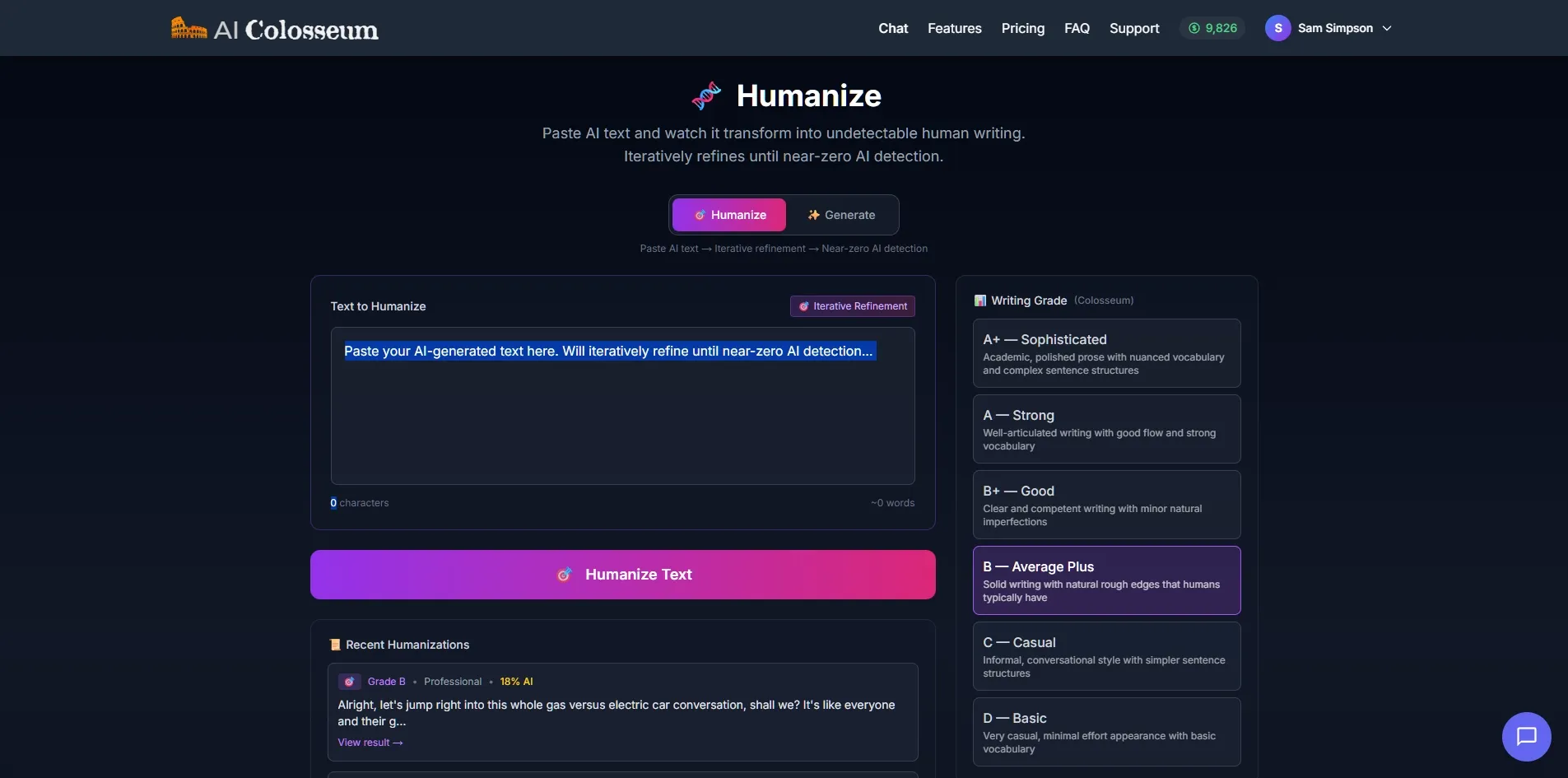
AI Colosseum's Humanize feature addresses this with sophisticated text transformation that converts AI-generated content into authentic-sounding human writing. Unlike simple paraphrasing tools, Humanize employs advanced natural language processing to:
• Vary sentence structure: Replace uniform AI cadence with natural human variation
• Add appropriate imperfections: Introduce subtle stylistic choices that feel authentically human
• Adjust tone: Choose from Academic, Professional, Casual, or Creative writing styles
• Self-score: Built-in AI detection scoring shows how "human" the output appears
The Six-Grade Quality System
Humanize offers six quality grades (A+ through D), allowing users to balance between human-like quality and processing time:
• A+ Grade: Maximum humanization with Deep Humanize iterative refinement. Multiple passes ensure the output is indistinguishable from human writing. Best for critical academic or professional documents.
• B-C Grades: Balanced humanization suitable for most use cases. Quick processing while maintaining natural flow.
• D Grade: Light humanization for internal documents or drafts where AI detection isn't a concern.
Custom Workflows: Automation Meets Intelligence
Beyond one-off conversations and Round Table discussions, AI Colosseum enables users to create custom workflows—repeatable, multi-step AI processes that automate complex tasks. Workflows combine the power of multiple AI models with conditional logic, branching, and sequential execution to handle sophisticated use cases.
What Are Custom Workflows?
Custom workflows are pre-configured AI pipelines that execute automatically based on triggers or manual invocation. Unlike standard conversations where you interact with one model at a time, workflows orchestrate multiple AI interactions in sequence, passing context and outputs between steps.
Example workflow: "Blog Post Creation Pipeline"
1. GPT-4o generates initial draft based on topic and keywords
2. Claude 3.5 Sonnet reviews for accuracy and improves structure
3. Perplexity adds current facts and statistics with citations
4. Humanize feature processes the content for authenticity
5. Final output delivered as formatted document ready for publication
Workflow Capabilities
AI Colosseum workflows support sophisticated automation patterns:
• Sequential Execution: Each step receives output from previous steps as context
• Parallel Processing: Run multiple AI queries simultaneously and merge results
• Conditional Branching: Route workflow based on AI outputs or user inputs
• Template Variables: Inject custom data into prompts at runtime
• Model Selection Per Step: Choose optimal AI model for each workflow stage
• Error Handling: Automatic retries and fallback models ensure reliability
Real-World Workflow Examples
Software Development Workflow
Developers use workflows to automate code review, testing, and documentation generation. A single workflow can generate unit tests (GPT-4o), review code for security vulnerabilities (Claude), generate documentation (Gemini), and suggest performance optimizations (DeepSeek)—all automatically.
Content Marketing Workflow
Marketing teams create workflows that research competitors, generate content ideas, write drafts, optimize for SEO, and generate social media variants—all from a single product description or topic. What took a team days now completes in minutes.
Research Synthesis Workflow
Academics and analysts use workflows to ingest multiple research papers, extract key findings from each (parallel processing across models), identify contradictions, synthesize conclusions, and generate formatted citations—automating literature review processes.
Building and Sharing Workflows
AI Colosseum provides an intuitive workflow builder where users can:
• Drag and drop workflow steps into sequence
• Configure prompts with dynamic variables
• Test workflows with sample inputs before saving
• Share workflows with team members or the community
• Schedule workflows to run automatically
Enterprise customers can create private workflow libraries that standardize how their teams use AI, ensuring consistent quality and compliance across the organization. This transforms AI from an ad-hoc tool into a reliable, repeatable business process.
Enterprise-Grade Infrastructure
Behind AI Colosseum's intuitive interface lies sophisticated engineering designed for scale, reliability, and performance.
Technical Architecture
Frontend: Built with Next.js 15 and React 19, leveraging server components and the App Router for optimal performance. React Virtuoso enables smooth scrolling through conversations with 10,000+ messages. TypeScript provides compile-time type safety, while Tailwind CSS 4 delivers a responsive, beautiful interface.
Backend: FastAPI (Python 3.11+) powers the API layer with async/await patterns throughout. WebSocket connections provide real-time streaming of AI responses with minimal latency. The provider manager implements automatic failover—if one AI service experiences downtime, requests automatically route to backup providers.
Database: Google Cloud Firestore provides scalable NoSQL storage with real-time synchronization. Conversations sync across devices instantly, with offline support ensuring users never lose work.
Infrastructure: Deployed on Google Cloud Run, AI Colosseum automatically scales from zero to thousands of concurrent users. Containerized deployments with Docker ensure consistent environments from development through production.
Intelligent Context Management
One technical challenge unique to AI Colosseum is managing context across multiple models with different context window sizes. The platform implements rolling summaries—as conversations grow long, older messages are intelligently summarized while recent context remains verbatim. This enables effectively unlimited conversation length while respecting each model's token limits.
Rate Limiting and Adaptive Cooldowns
Each AI provider enforces different rate limits. AI Colosseum's provider manager tracks usage in real-time and implements adaptive cooldowns—temporary delays that prevent rate limit violations. This happens transparently to users, who simply see consistent performance across all models.
Subscription Model and Fair Pricing
AI Colosseum uses a credit-based subscription system that fairly reflects the varying costs of different AI models. Each model has a credit multiplier based on its API costs:
• GPT-4o: 3× multiplier (most expensive, highest capability)
• Claude 3.5 Sonnet: 2.5× multiplier
• Gemini Pro: 2× multiplier
• GPT-3.5 Turbo: 0.5× multiplier (most cost-effective for simple tasks)
Subscription Tiers
Free Tier: 100 credits/month. Perfect for casual users to explore the platform and basic multi-model features.
Pro Tier: $19.99/month for 2,000 credits. Ideal for professionals who regularly use AI for work. Includes priority support and faster response times.
Colosseum Tier: $49.99/month for 10,000 credits. Designed for power users running extensive Round Table discussions and heavy Humanize usage.
Enterprise: Custom pricing with unlimited credits. Includes team workspaces, SAML SSO, audit logs, dedicated infrastructure, and 99.9% uptime SLA.
Team Collaboration Features
Enterprise customers gain access to sophisticated team collaboration tools:
• Shared Workspaces: Teams share access to conversations, Round Tables, and Humanize history
• Role-Based Access Control: Administrators control who can access premium models or sensitive features
• Credit Pool Management: Shared credit pools with usage tracking per team member
• Audit Logs: Comprehensive logging of all AI interactions for compliance and security
• SAML SSO: Single sign-on integration with existing identity providers
Conversation Management and Export
AI Colosseum treats conversations as first-class objects with full CRUD operations:
• Folder Organization: Group conversations by project, topic, or team
• Advanced Search: Full-text search across all conversations with filters for date, model, and message content
• Export Formats: Download conversations as PDF (formatted), JSON (for programmatic use), or CSV (for data analysis)
• Favorites and Pinning: Mark important conversations for quick access
• Archive and Restore: Keep your workspace clean while retaining historical data
Security and Privacy
AI Colosseum implements security best practices at every layer:
• Data Encryption: All data encrypted at rest and in transit using industry-standard protocols
• JWT Authentication: Secure token-based authentication with automatic expiration
• OAuth Integration: Sign in securely with Google
• Content Security Policy: Strict CSP prevents XSS and injection attacks
• No Data Retention: AI Colosseum doesn't train models on user data. Conversations remain private.
Performance Optimizations
Several technical innovations enable AI Colosseum to deliver exceptional performance:
Optimistic UI Updates: The interface updates immediately on user actions, syncing with the server in the background. This creates the illusion of instantaneous response even on slower connections.
Virtualized Rendering: Using React Virtuoso, only visible messages are rendered in the DOM. This enables smooth scrolling through conversations with tens of thousands of messages—something impossible with traditional rendering approaches.
Progressive Web App: AI Colosseum works offline and can be installed on desktop and mobile devices like a native app. Service workers cache frequently accessed data for instant loading.
Edge Caching: Static assets and API responses are cached at Google's global edge network, ensuring low latency regardless of user location.
The Future of AI Colosseum
AI Colosseum represents just the beginning of multi-model AI orchestration. The roadmap includes several ambitious features:
• Custom Model Integration: Allow enterprise customers to integrate their fine-tuned models
• API Access: Programmatic access to Round Table and Humanize features for developers
• Workflow Automation: Build multi-step AI workflows with conditional logic and branching
• Knowledge Bases: Upload documents that all AI models can reference in conversations
• Prompt Templates Library: Community-contributed templates for common use cases
• Advanced Analytics: Insights into which models perform best for different task types
Why AI Colosseum Matters
As AI capabilities continue to advance, the ability to orchestrate multiple models becomes increasingly valuable. Different models excel at different tasks—GPT-4 for reasoning, Claude for analysis, Gemini for multimodal understanding, Perplexity for research. AI Colosseum is the first platform to fully embrace this reality, treating AI models not as competitors but as collaborators.
The platform democratizes access to cutting-edge AI. Instead of requiring separate subscriptions and technical expertise to work with multiple models, AI Colosseum provides a unified interface accessible to anyone. This lowers barriers to AI adoption for individuals, small businesses, and enterprises alike.
Most importantly, AI Colosseum demonstrates what's possible when we move beyond single-model thinking. Round Table discussions produce insights no single model could generate alone. This collaborative approach represents the future of AI interaction—not humans vs AI, or humans + AI, but humans orchestrating AI collaboration.
Getting Started with AI Colosseum
AI Colosseum offers a generous free tier to explore the platform. No credit card required—just sign in with Google and start chatting with 16 AI models. The free tier includes access to Round Tables and Humanize features, allowing you to experience the full platform capabilities.
For professionals and teams who need more capacity, paid plans start at just $19.99/month—less than a single ChatGPT Plus subscription, but providing access to 16 models instead of one.
Enterprise organizations interested in team features, dedicated support, or custom deployments can contact the KumoKodo.ai team directly for tailored solutions.
Conclusion
AI Colosseum represents a paradigm shift in how we interact with AI. By unifying 16 leading models, enabling multi-AI collaboration through Round Tables, and providing tools like Humanize for practical content transformation, the platform addresses real pain points that have plagued AI users since the technology went mainstream.
Built by KumoKodo.ai with production-grade architecture, AI Colosseum combines innovative features with enterprise reliability. Whether you're a developer seeking code review, a researcher synthesizing literature, a business strategist testing ideas, or a content creator refining AI-generated text, AI Colosseum provides the tools to work smarter and faster.
The future of AI isn't about picking the "best" model—it's about orchestrating multiple models to solve complex problems collaboratively. AI Colosseum makes that future available today.
---
*Want to experience AI Colosseum yourself? Visit aicolosseum.app to start your free trial. For businesses interested in custom AI platforms like AI Colosseum, contact KumoKodo.ai to discuss your project.*