Skip to content

Tetrameter · Public beta

Four measures of what your AI actually costs.

How we built a measurement platform for AI inference that reports energy, carbon, water and land — with cost sitting outside them as the same consumption priced — measured per task rather than per query, because an agent does not make one request. A reference implementation of the Green Software Foundation's Software Carbon Intensity specification for AI, published open source under Apache 2.0, with the auditor's evidence pack as the paid product.

Measures + cost
4
Measures + cost
Engine tests
207
Engine tests
Runtime deps in core
0
Runtime deps in core
Retention
13 mo
Retention
Product
Tetrameter
Industry
FinOps · Sustainability · Assurance
Services
Product + full-stack development
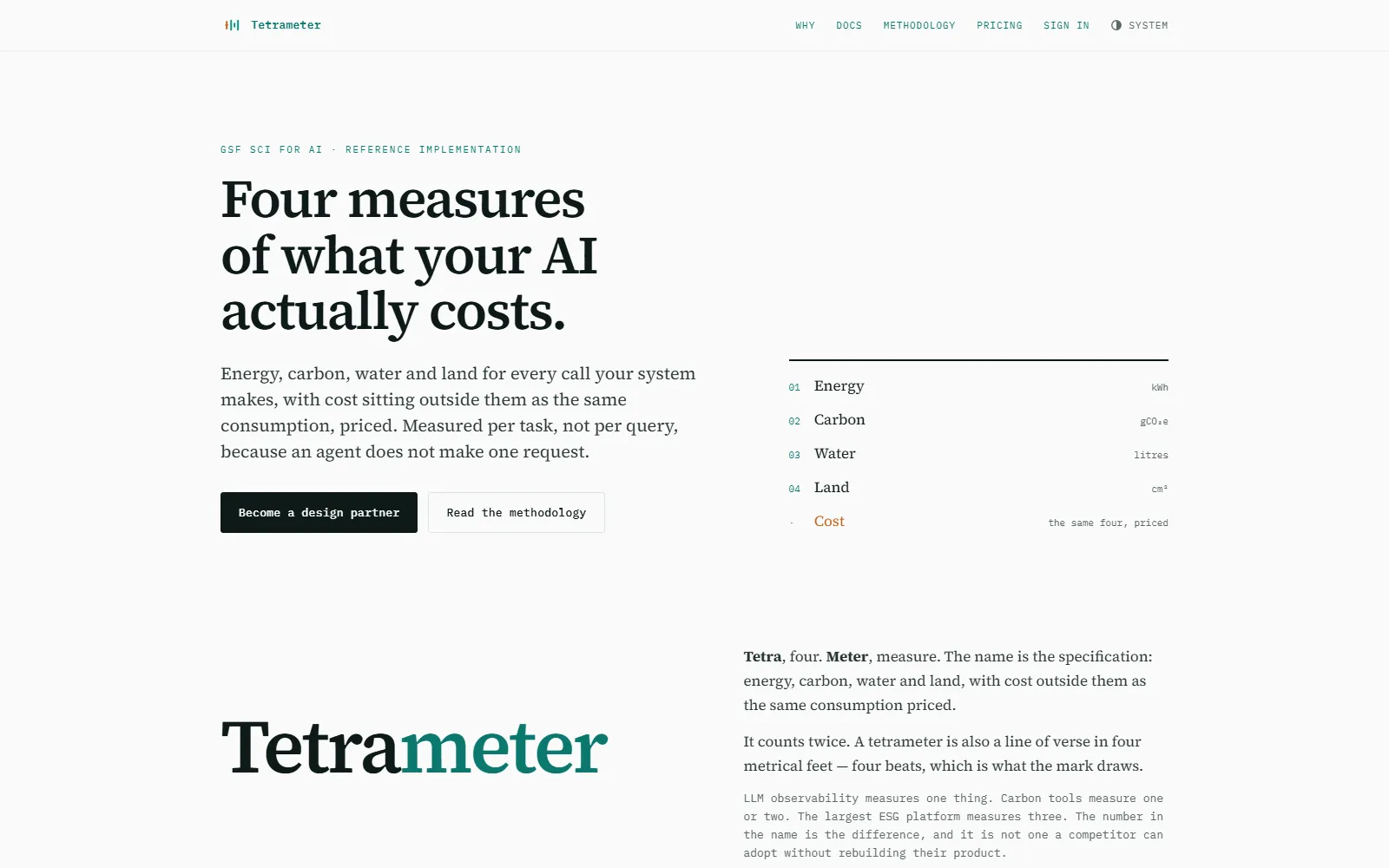
Tetrameter — energy, carbon, water and land for AI inference
tetrameter.ai — the four measures, and cost outside them
The challenge

Two questions, one missing number.

Companies are spending fast-growing amounts on AI and almost none of them can say which customer, feature, or team that money was spent on. From 2027, California law requires large companies to report supply-chain emissions with an independent third party checking the work — and AI is the part of that footprint growing fastest. Both questions have the same answer, because for AI, cost and carbon are the same variable.

LLM observability measures one thing

Langfuse, Helicone, Portkey and Datadog track tokens and dollars. None of them produce a figure a sustainability lead can put in a disclosure, and most of them capture prompts — which puts them out of bounds in banks, healthcare, legal, and government at any price.

Carbon platforms can't see the calls

Watershed, Persefoni, Greenly, Sweep and Normative price at $50–250K a year and have no path to individual inference calls. They need per-model coefficients for AI and have nowhere to get them.

A single tidy number would be a lie

For a proprietary API model whose operator publishes nothing about its energy draw, the honest answer spans two orders of magnitude. A tool that prints one confident figure isn't more accurate than one that prints a range — it's less honest, and limited assurance explicitly tolerates a range.

An auditor tests the record, not the formula

The assurance standard doesn't ask whether your number is right. It asks whether your method is documented, each figure traceable, your factors tested, and whether you restated history when a coefficient changed. That is a twelve-month operational record. You cannot produce it retroactively.

Our solution

Publish the tape measure. Sell the surveying.

The arithmetic is public standards work — we gain more by being its reference implementation than by hiding it. What customers pay for is the system around it.

01

You cannot get a bare scalar out of it

Every quantity the engine returns carries an uncertainty range, an evidence tier, and the list of factors it came from. There is no API shape that hands you a naked number, and that is deliberate — a figure without its provenance is not a figure an auditor can test.

02

Weakest-link tiering

Tier 1 is a class average from measured open-weight models — the ceiling for any proprietary API model. Tier 4 is a deployment measurement combined with the grid's carbon intensity at the hour of the call. A composite figure is always reported at the weakest tier it depends on, because a chain is only as good as its worst link.

03

Metadata-only, enforced by the type system

No field in the collector's record type can hold a prompt or a completion. A sanitiser strips unknown keys, and a test spreads an entire provider response into a record and asserts the content does not survive. The guarantee is structural, not a policy somebody has to remember.

04

A restatement log, in the library

When a coefficient changes, every historical figure derived from it moves — and in a disclosed inventory that is a restatement event requiring documentation. The log ships inside the library so a report can cite it mechanically, including the entry where we had overstated a model roughly threefold.

The key insight

The line between open and paid.

One rule decides what ships in the public repo: anything that produces a number you would put in a disclosure is open source; anything that produces a recommendation we would bill for is not. The coefficient engine and the collector are Apache 2.0 — a security review should be able to read them rather than take our word. Waste findings and savings estimates are hypotheses rather than measurements, so nobody needs to audit them to trust a disclosure, and they stay private. The trademark, notably, is not granted: “built on Tetrameter” is always fine, calling your fork Tetrameter is not.

Why the free version doesn't cannibalise

Coefficients rot silently. Grids get cleaner every year, model prices change monthly, new models appear weekly — and a downloaded copy of the library will keep producing confident, wrong numbers without telling you it has drifted. The subscription is the upkeep, the same way almost nobody does their own VAT returns despite the arithmetic being trivial and public.

Technical architecture

Stack and pipeline.

The open engine

  • TypeScript 5.9, ESM, strict + noUncheckedIndexedAccess
  • Zero runtime dependencies in both core and the collector
  • 207 Vitest tests, including pinned uncomfortable results
  • Every factor carries source, version and retrieval date
  • Reconciliation test against Google's published Gemini figure
  • Apache 2.0, published via GitHub Actions Trusted Publishing

The hosted product

  • Next.js App Router on Vercel, hand-rolled CSS shared with the report renderer
  • Neon Postgres control plane, raw parameterised SQL
  • Org-per-key tenancy, API keys hashed at rest
  • Metadata rows at ~60 bytes compressed — 13 months of 25M calls/mo is ~20 GB
  • Planned: batched ingest on Cloud Run — ~1000× fewer invocations than per-event serverless
  • Planned: ClickHouse event store at ~10M events/month, behind a query interface
What it measures

Four measures, and cost.

Energy

Kilowatt-hours per call, from measured open-weight benchmarks plus host and PUE overhead — with the range it deserves.

Carbon

Grams CO₂e, grid intensity applied to the energy figure and reported at the weakest evidence tier in the chain.

Water

Litres consumed — the measure most AI reporting omits entirely, and the one data-centre siting fights are actually about.

Land

Square centimetres. Renewable grids use more land per kilowatt-hour, not less — asserted in a test so nobody quietly 'fixes' the inconvenient result.

Cost

Outside the four, because it is the same consumption priced. Sold to engineering on this line; renewed by sustainability on the other four.

The evidence pack

The twelve-month operational record an auditor actually tests — traceable figures, tested factors, and a documented restatement history.

The results

Priced between two worlds.

$499/mo
Team plan
$1,999/mo
Business plan
>92%
Gross margin at Business
3–5
Customers to break even

To the engineering lead

  • Cheaper per request than Datadog LLM Observability by 20–30×
  • Cost attribution by customer, feature, team and model
  • Per-task measurement — an agent trace, not a single query
  • Metadata-only, so it clears reviews prompt-capturing tools can't

To the sustainability lead

  • A tenth of an enterprise carbon platform, for the fastest-growing line
  • Per-customer statements your own customers can put in their reports
  • A restatement log and an evidence pack built for limited assurance
  • A methodology anyone can read, fork, and check — including your auditor
Where we drew lines

What Tetrameter deliberately does not claim.

No embodied hardware carbon

Real, and not reliably attributable to a single inference. Inventing an allocation would be exactly the confident fiction this library exists to argue against.

No training-run amortisation

Same reasoning. The training that produced the model is a real cost that nobody can honestly divide across the calls that follow it.

No network transit

Left out and said so, in the README rather than a footnote. The boundaries are part of the methodology, not an omission to be discovered later.

Built with

Technology stack.

TypeScript 5.9Next.js App RouterReactNeon PostgresVitestpnpm workspacesGoogle Cloud Run (planned)ClickHouse (planned)Apache 2.0npm Trusted PublishingVercel
See it live

Want to know what your AI actually consumes?

Read the methodology at tetrameter.ai — the engine is open source, so you can check the numbers before you trust them. Design-partner slots are open.